Black-necked Crane Festival
Crane Festival
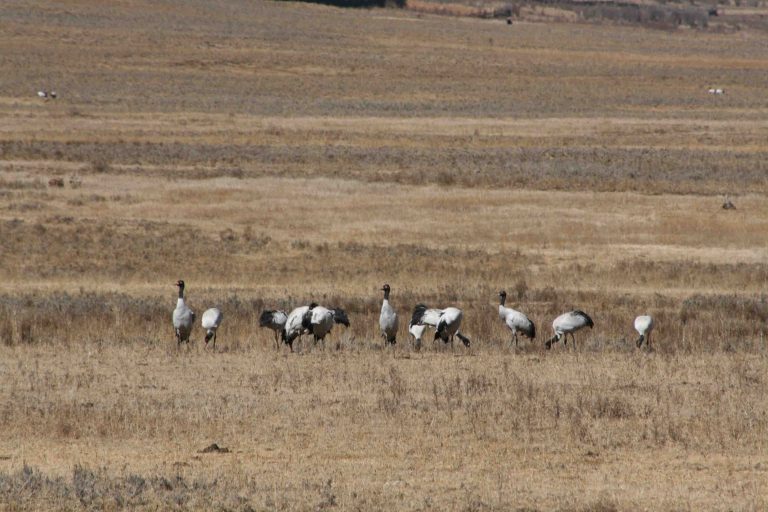
The annual Black-necked Crane Festival, held in November at Gangtey Monastery. The festival is organized by the Gangteng-Phobjikha Environment Management Committee. It was launched by the Royal Society for Protection of Nature, as part of its Integrated Conservation and Development Program (ICDP). The festival is celebrated marking the arrival of the Black-necked Cranes to the Gangtey-Phobji glacial wide valley that spreads across the central highlands of Bhutan, also a RAMSAR Site. The festival features cultural programs, including folk songs, environmental songs, and traditional mask dances performed by monks, locals, and schoolchildren. The highlight of the festival is the popular ‘crane dance’ in which schoolchildren perform dressed as cranes. This festival is attended by many local, regional tourists and international visitors surpassing 1,000 visitors in 2024. Phobjikha Valley remains one of the most important winter habitats for these endangered birds in Bhutan.
Gangtey Monastery
Gangtey Monastery stands as a sacred pillar of the Nyingmapa tradition of Tibetan Buddhism. As the primary seat of the Pema Lingpa lineage, its spiritual legacy traces back to 15th-century prophecies by the revered treasure-revealer Pema Lingpa, with the monastery itself established in the early 1600s The monastery shares its name with the surrounding Gangtey village and overlooks the breathtaking Phobjikha Valley—a winter sanctuary for endangered black-necked cranes. According to local belief, these majestic birds circle the monastery three times upon arrival from Tibet each winter, repeating this celestial ritual before their return migration.
Kyabjé Gangteng Tulku Rinpoche
Venerated as Bhutan’s patron saint, Pema Lingpa’s legacy is woven into the nation’s cultural fabric. His legendary feats—revealing hidden terma (sacred Dharma treasures) and defying skeptics through miraculous displays—remain central to Bhutanese folklore. In the mid-16th century, his reincarnation, the 1st Gangteng Tulku, fulfilled Pema Lingpa’s prophecy by establishing Gangtey Monastery at its destined location. Remarkably, every subsequent Gangteng Tulku has been reborn in Bhutan, preserving an unbroken spiritual lineage. The current 9th Gangteng Tulku, born in 1955 near Trongsa, embodies this sacred continuity. After rigorous monastic training at Trongsa Dzong, he ascended to the throne at Gangtey Monastery, upholding its role as the heart of the Pema Lingpa tradition.
More on Black-necked Crane Festival here.